Introduction
‘Consider our landscape and the creations it supports, our vital codependency; a bond hidden until its absence is felt.’
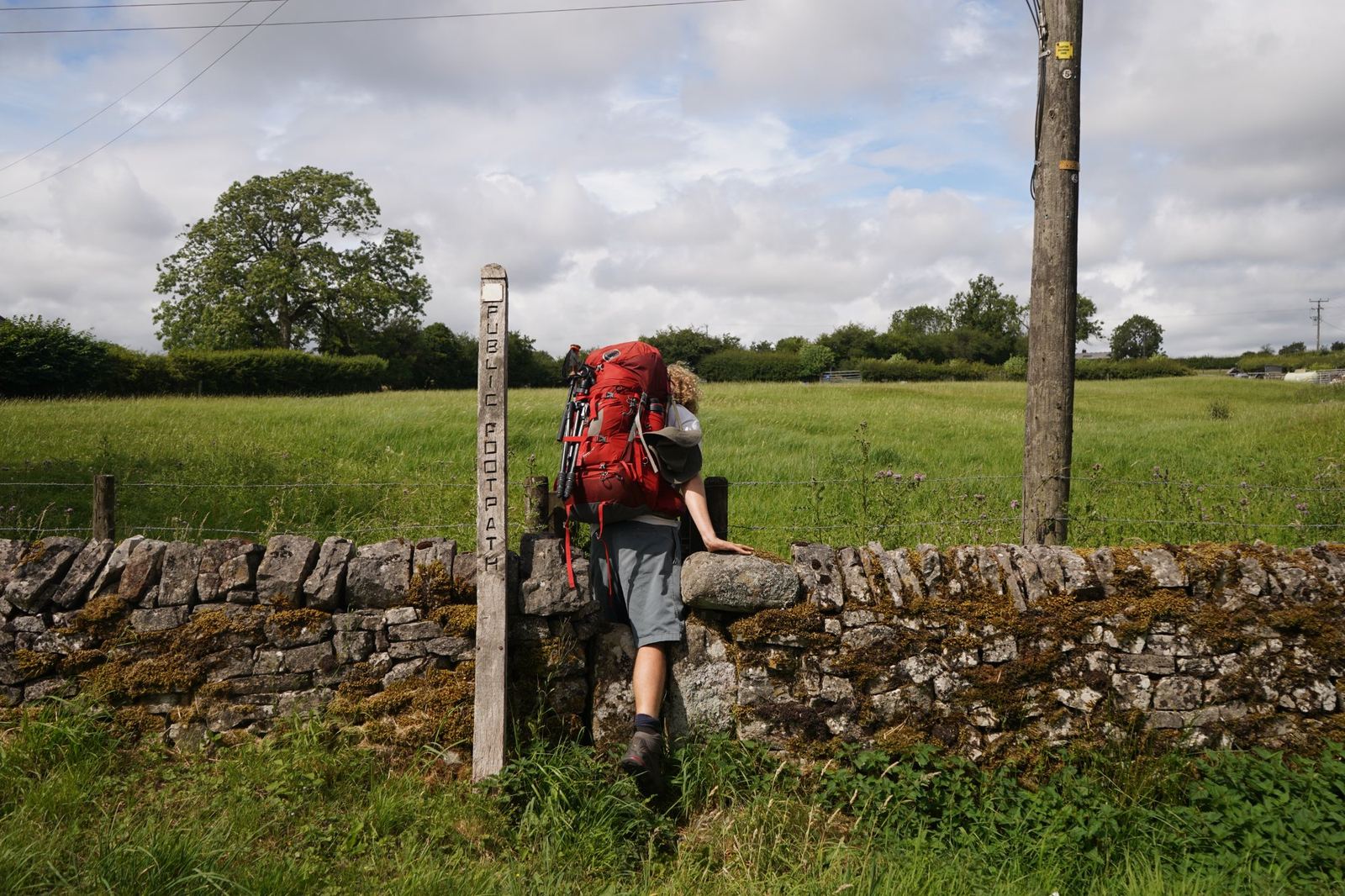
We walked the length of Britain to document this island’s heritage crafts and to raise money doing it. The idea was to be slow, walk from Spring into early Autumn. Walking gave us time, something, as a younger generation, we feel we have less of. Time revealed the beauty of slow processes: the turning of Spring, hawthorn, red campion and cow parsley in bloom, the hedgerows humming with chiffchaff, chaffinch, blackbird and robin.
Spring was on the mind of makers we visited. For many, their work is governed by the pace of the seasons; the wool in the fields, the withies in their orchards, the rushes by the rivers. Patience is required. Creation by hand works on a timeframe that supports the natural ecosystem. It shows the important and tangible connection we share with the living world, despite now being radical by today’s standards of production.
It is this connection that explains our appreciation for a straight line drawn by hand. The imperfection is human. Maybe we see a little bit of ourselves in handmade objects. In all the workshops we visited there was spirit carried over from maker to object, their work had life. The same way watching a bird make a nest, a rabbit a warren, or a tree and its carefully constructed roots.
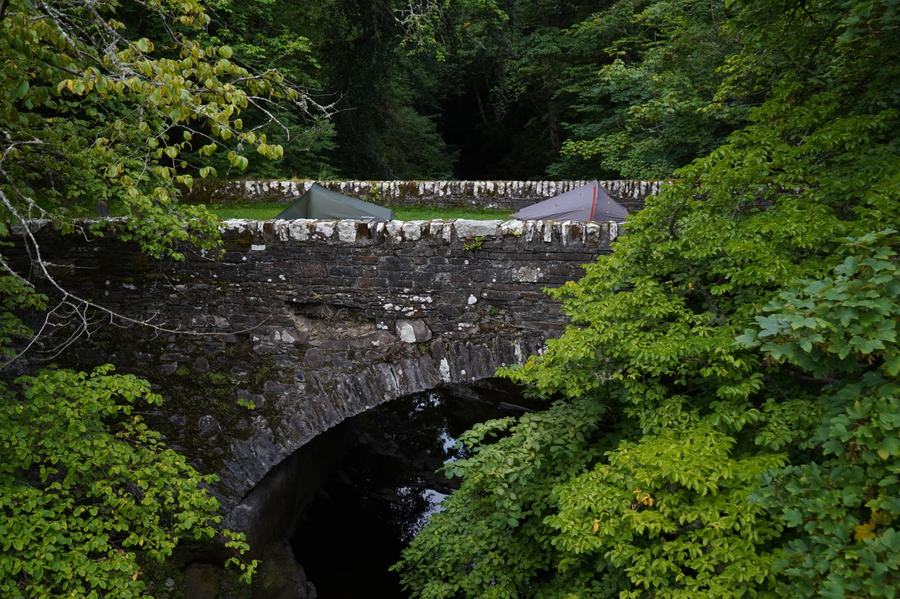
Camping wild, Scotland
Chapter One
‘Craft is cultural infrastructure, not nostalgia. It is fundamental to the identity of place and belonging.’
The first week of walking revealed a lot. People come to Cornwall for its coasts but we had discovered its magic elsewhere, heading inland through cairns, hill forts and burial grounds, interspersed with clay chimneys revealing the once vast network of Cornwall’s tin shafts. The layers of time opening up in front of us.
The seaside village of Gorran Haven was our first port of call, where we met withy pot maker Tony Pinto. The withy pot was traditionally used for catching crab, an essential skill to any commercial fisherman before industrialisation. We boarded Tony’s vessel, Joy, named after his late wife, and between hauling pots and detailed descriptions of landmarks he charted his life. Son of an Italian prisoner of war, his father worked as a farmhand and fell in love with the farmer’s daughter. Tony was born in Gorran Haven, he watched pots being made on the harbour wall from a young age, and now teaches the craft himself at the age of 65.
We witnessed first hand the withy pot’s ability to bring a community together. It acts as a symbol of an old way of life, one that connects to place and stands as a physical reminder of why home exists.
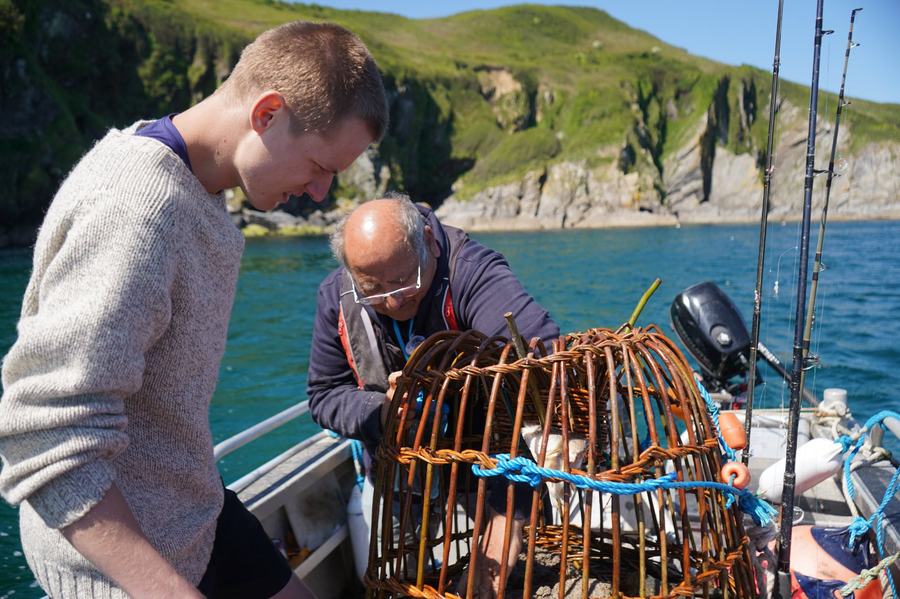
Tony Pinto, Gorran Haven, Cornwall
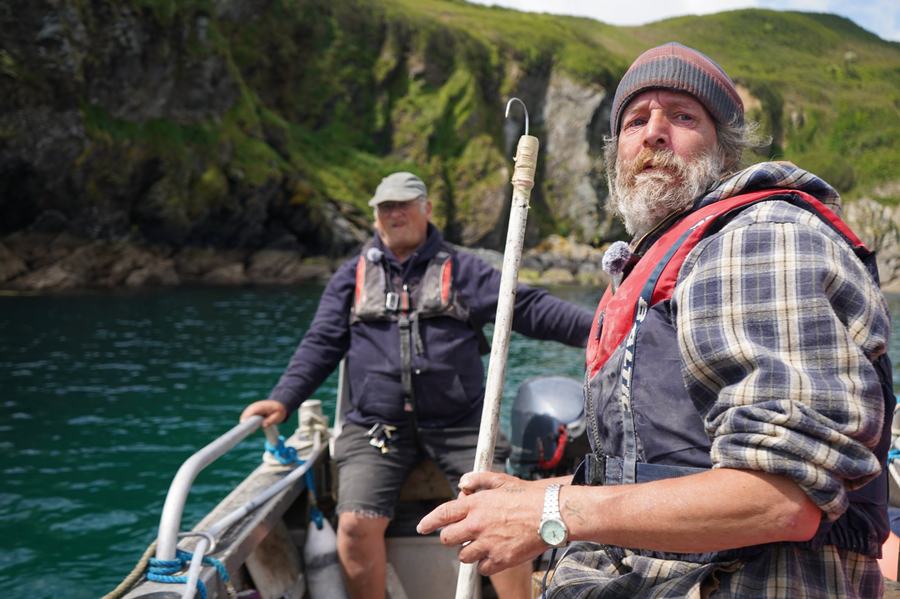
Out on the water, Gorran Haven
Interview
An Interview with Freddie Armstrong & Joe De Ferranti
You asked the question before the walk of whether traditional craft skills offer a way back to ourselves as a part of the natural world. What would your answer to that question be now?
F: Land gives us materials, and so automatically with craft there is a co-dependency between us and the land. We’re becoming increasingly dissociated from tangible connections that we share with the natural world, and using our hands is a reminder to keep whatever connection we have left. With craft, one is working often on timeframes that support a natural ecosystem. The revival we are seeing is not nostalgia. It is people recognising that something essential has been lost, and finding that the act of making brings them closer to feeling alive within the world rather than separate from it.
J: The craftspeople we met hold an immense, grounded knowledge of their natural environment. It came from appreciation and love, but also from its relationship to how they make a living. Most people no longer need this knowledge to survive, yet what they showed us is how much sits within it. With Lorna Singleton, a swill basket maker in the Lake District, it became clear. She knew everything there was to know about oak. What to cut, when to coppice, how to read the material. That knowledge exists because it has to. When crafts were part of everyday life, people were engaging with nature. The only way out feels like shifting towards making, choosing to create rather than just consume.
Did you observe similar challenges being faced by the makers despite working across different crafts and landscapes?
F: What was so interesting was the craft ecosystem we encountered. Historically different craftspeople relied on each other’s work to sustain themselves. For example, a basket maker might provide tree bark to a local tannery. An abundance of basket willow from Somerset, might be sent to Cornwall for Withy Crab Pots. So you begin to understand these really essential connections between different crafts as a social natural network. However, those systems are breaking down, and makers are becoming increasingly more isolated. I would say that there is also a skill gap at the moment given old makers can’t necessarily afford to have an apprentice. Training is really difficult, and craft isn’t seen to hold a place in the modern world that operates on a rapid time scale.
What moments during the walk made most visible our loss of connection to both land and material?
J: The moments that made it most visible were where two worlds collided. We’d be camping, cooking on a stove, completely exposed to the conditions, and then suddenly step into something like a supermarket. There’s a strange dissonance in that. You feel relief, even gratitude, for the ease and abundance. But it makes you aware of how removed those systems are from anything tangible. Food appears without any sense of season, place, or process. Materials arrive finished, with no trace of where they’ve come from. The next moment we’d be speaking to makers who could trace everything back — wood to woodland, wool to flock, clay to ground. We realised how little of that awareness exists in everyday life.
How did walking through the landscapes that are in dialogue with the crafts you encountered help you understand both process and maker?
F: I think by walking, it immediately allowed us to begin to understand the level of commitment these crafts take. The time it took to get from one place to the other not only gave us time to think on our conversations with makers, but also actually to understand the mundane natural rhythms and processes they depend on. Whilst walking through different seasons, much of the making we saw was seasonal. The final object comes from an annual process. For example, Jessica, running the tannery, collects her hides in the winter, the bark in late spring and does the tanning through the warmer months. Withy crab pots are made through the winter when the willow is fresh and can bend, the fishing done in the summer when the seas are calmer.
In a world increasingly defined by speed, how did it feel to engage with practices that are bound to time and often require a lifetime of dedication?
J: It was both daunting and inspiring being around makers who in some cases started at fourteen. With technology, the choice of what to devote your life to can feel almost paralysing. What stood out in the people we met was a kind of certainty. You could see it in their work ethic and the way they spoke about what they do. There’s no sense of changing direction. Their lives and crafts were completely intertwined — a clarity of purpose that feels far removed from how work is often framed today.
F: What struck me in those conversations with older makers was how settled they were. They couldn’t imagine doing anything else. Their sense of purpose was fulfilled, their work was meaningful to them and gave them security in their home and place. Beyond that were stories specific to an area and region, how craft has shaped the people living there. These are people with a deep understanding of place, aware of local histories that most have forgotten. I’d hate for us to lose that.
Robert Macfarlane often describes walking as a way of attuning to layered histories in the landscape. Was there a moment that you felt aware of our island’s history and how did that influence your perception of Britain?
F: In some ways, I felt occasionally that we were properly time travelling. In Dartmoor for instance, we walked over really ancient ground. I mean, we slept under the Beckamoor Cross, a twelfth century way marker. We were walking over old tors and not just historical sites, but really ancient geology. You begin to wonder how minute one lifetime is in comparison to the whole history of this island — the many people that have walked before you and looked out across the same view. I really tried to imagine what they would have been wearing and what comforts they would have relied on.
You both lived an analogue life for three months; face-to-face conversation, sharing knowledge, walking and the handmade. Coming from a generation that has left the analogue age, what should we relearn from past ways of living?
J: In normal urban life you become quite independent. People are more closed off, and talking to strangers can feel awkward. Through walking and engaging with this sprawling network of makers, we found ourselves in conversation constantly. It would happen anywhere, with anyone, and each interaction fed naturally into the next in a way that is hard to replicate in a typical routine. This analogue way of walking and talking is what led us to the makers who form this exhibition. It required a kind of trust in a much slower process, but one that proved far richer.
Why should we care for heritage crafts today? Was there a feeling among the makers you met that their knowledge might not be carried forward?
F: I think it is a matter of identity, our humanity is questioned so much at the moment that it can be hard to relate to oneself. Simple things humans have done forever is to make — our tools and shelter to grow food and be comfortable. If we lose that ability and pay no attention to our heritage crafts, we lose that history, and our understanding that we are part of an ecosystem, not indifferent to it. Initially starting the walk, I felt that one of the biggest issues we would encounter was a general lack of interest from young people on skills which now felt irrelevant. This actually wasn’t the case at all. There was so much enthusiasm to learn and in fact we saw many young makers thanks to the work of QEST and Heritage Crafts. At the moment, the biggest obstacle is funding and how one can have access to training and apprenticeships. Beyond that is also the pressure to be financially successful in your craft, you have to be very good and to be very good takes many, many years of training. Craft becomes a complete dedication, and as Joe mentioned earlier, young people are now in a world full of options with much fewer opportunities to train.